
What counts as an ugly baby animal?
There is no scientific group called ugly baby animals and no objective ranking of the ugliest young species. The phrase combines two human judgements: one about an unfamiliar appearance and another about age. A hatchling bird with bare skin, a wrinkled newborn mammal or a salamander larva with external gills may look unfinished only because people expect the coat, feathers or proportions of an adult.
A useful comparison starts with identity and life stage. Is the animal newly hatched, dependent on a parent, transforming through metamorphosis or already an adult that retains juvenile anatomy? Those questions explain far more than a caption that simply calls the animal ugly or cute.
The axolotl that keeps a larval form
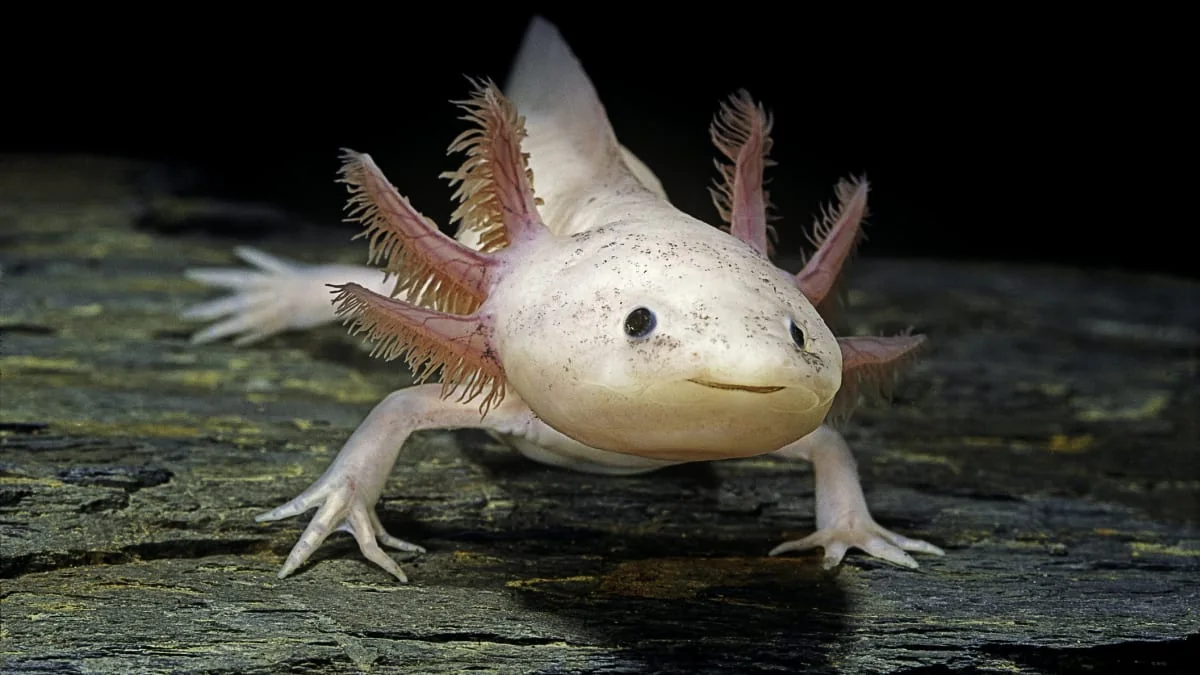
Most mole salamanders undergo a transformation from an aquatic larva to a more terrestrial adult. The axolotl normally reaches reproductive maturity while keeping external gills, a tail fin and an aquatic body. This is paedomorphosis, the retention of juvenile characteristics in a mature animal, not evidence that every axolotl is a baby.
The feathery gills increase surface area for gas exchange. Wild axolotls are generally dark and mottled, while the familiar pale pink form is common in captivity through selective breeding. Age, developmental pattern and captive colour should not be collapsed into one story about cuteness.
Why newborn mammals can look bare or wrinkled
Many mammal pups are born with different proportions and less developed coats than adults. Naked mole-rats are an important caution because adults also have sparse hair. Their appearance is connected to life in stable underground tunnels, while tactile hairs remain useful for navigation. A hairless look does not by itself identify an animal as newborn, sick or neglected.
Young mammals depend on species-specific care, temperature and nutrition. A photograph rarely reveals enough to judge health. If a wild infant appears to need help, the safe response is to contact a qualified local wildlife rehabilitator rather than handling or feeding it from a general web guide.
Bare chicks, soft shells and changing proportions
Bird chicks vary greatly. Some hatch mobile and covered in down, while others hatch relatively helpless with sparse covering and closed or partly opened eyes. Adult feathers, head shape and body proportions arrive over time. A bare chick can therefore look unlike the adult pictured in a field guide without anything being wrong.
Reptile and amphibian young follow different schedules. A hatchling turtle begins with a small shell that continues to grow; a salamander may pass through an aquatic larval stage before metamorphosis. The word baby hides these biological differences, so the species and developmental stage should always be named.
Why the same young animal can look cute and ugly
Research on baby schema examines responses to features such as relatively large eyes and round faces. These features can influence attention and perceived cuteness, but they are not a universal formula and do not explain every reaction to every species. Familiarity, movement, context and personal experience also shape judgement.
Calling a young animal ugly can be playful, but the label should not replace husbandry, welfare or natural-history information. The most useful question is not whether a baby wins a beauty contest. It is what stage the animal is in, which structures are still developing and how adults provide or replace the care it needs.