Definition and identity
What is a goblin shark?
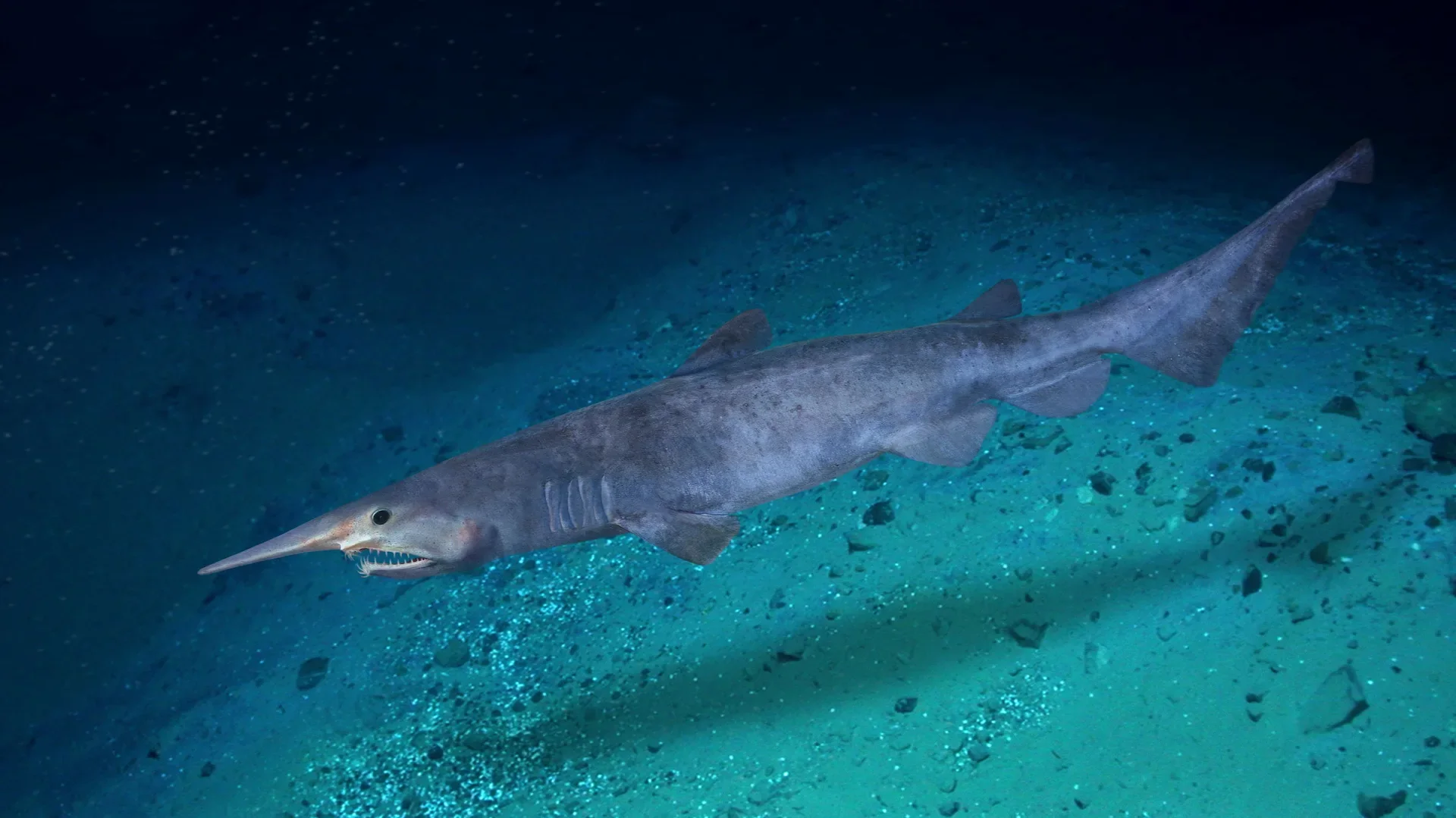
The goblin shark is the only living species in its family. It belongs to the lamniform sharks, the same broader order that includes makos and the great white, but its lineage and body plan are distinctive.
Most knowledge comes from animals caught by deep-water fisheries or found as specimens. That matters because colour, posture and soft tissue can change after capture. Live observations in the deep sea remain exceptionally rare.
Goblin shark biology
Why does the goblin shark have a long nose and extending jaws?
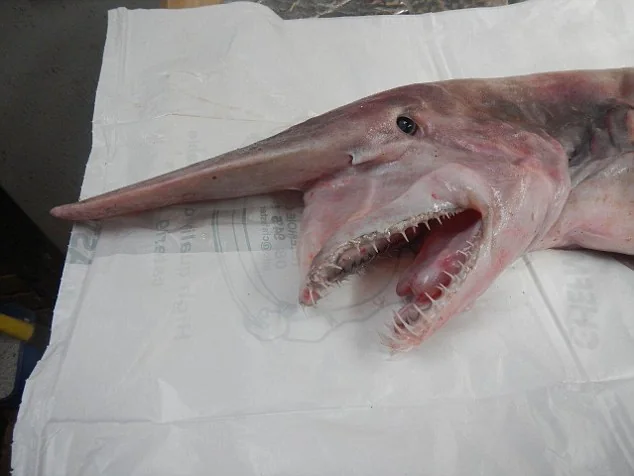
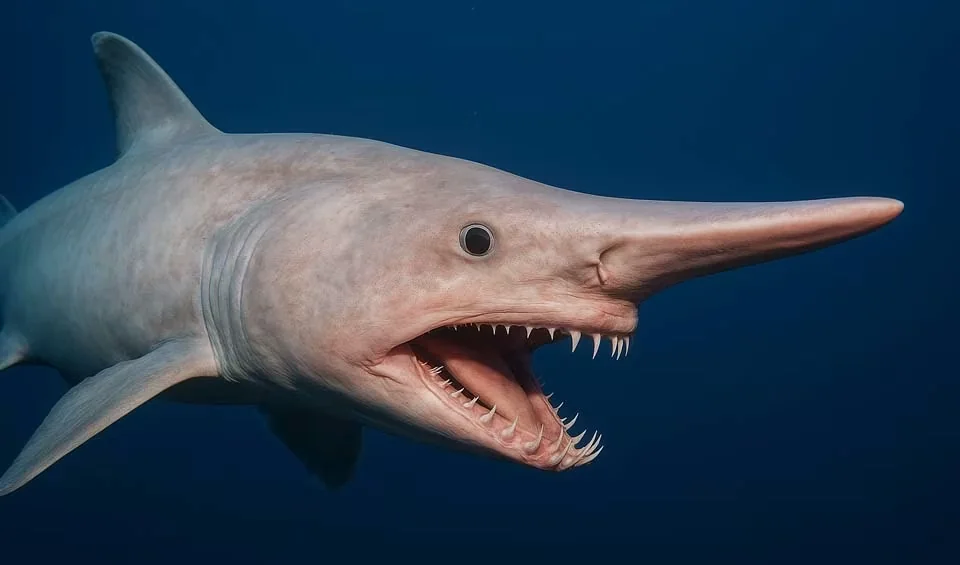
The flattened projection in front of the eyes is called a rostrum. It contains electroreceptors that can detect weak electrical fields produced by other animals, helping the shark investigate prey when light is limited.
The jaws are attached in a way that allows them to shoot forward. When the shark strikes, the mouth moves rapidly toward prey and then retracts. The resulting open-jaw photographs look extreme because they capture a feeding movement rather than the shark's resting face.
Goblin shark biology
Where do goblin sharks live?
Goblin sharks have been recorded in widely separated parts of the world's oceans, including waters near Japan, Australia, New Zealand, southern Africa, Europe and the Americas. Records are sparse, so mapped points do not necessarily show the full distribution.
They are associated with deep water along continental margins and oceanic slopes. Juveniles have sometimes been recorded shallower than large adults. Recent deep-sea observations continue to extend the known range and depth of the species.
Goblin shark biology
What do goblin sharks eat, and are they dangerous?
Stomach records indicate a diet that includes fish, squid and crustaceans. A soft body, sensory rostrum and projecting jaws fit a predator that does not rely on long, high-speed pursuits.
Goblin sharks live far from ordinary swimmers and divers. They are not regarded as a practical danger to people. Their teeth and jaws are feeding tools for deep-water prey.
Conservation
Conservation status: Least Concern
The goblin shark is caught occasionally in deep-water fisheries, but it is not currently assessed as globally threatened. Its apparent rarity should not be confused with a measured population decline because deep habitats remain poorly sampled.
Evidence and further reading
Goblin shark sources
Source 1 · Australian Museum
Goblin Shark, Mitsukurina owstoniUsed for: Identification, records, morphology and diet.
Source 2 · Florida Museum
Goblin SharkUsed for: Biology, habitat, distribution and conservation status.
Source 3 · Australian Government Fish
Goblin Shark 2023 Report CardUsed for: Current Australian and global assessment context.